Dubai’s Strategic Position in the Strait of Hormuz Crisis – and What Europe Can Learn
Energy Under Pressure
Dubai’s Strategic Position in the Strait of Hormuz Crisis – and What Europe Can Learn
The ongoing tensions surrounding the Strait of Hormuz have once again exposed one of the most critical vulnerabilities in the global economy: energy security.
With nearly 20% of the world’s oil and liquefied natural gas passing through this narrow corridor, any disruption immediately sends shockwaves through global markets. ()
But while the crisis is global in nature, its impact is not evenly distributed.
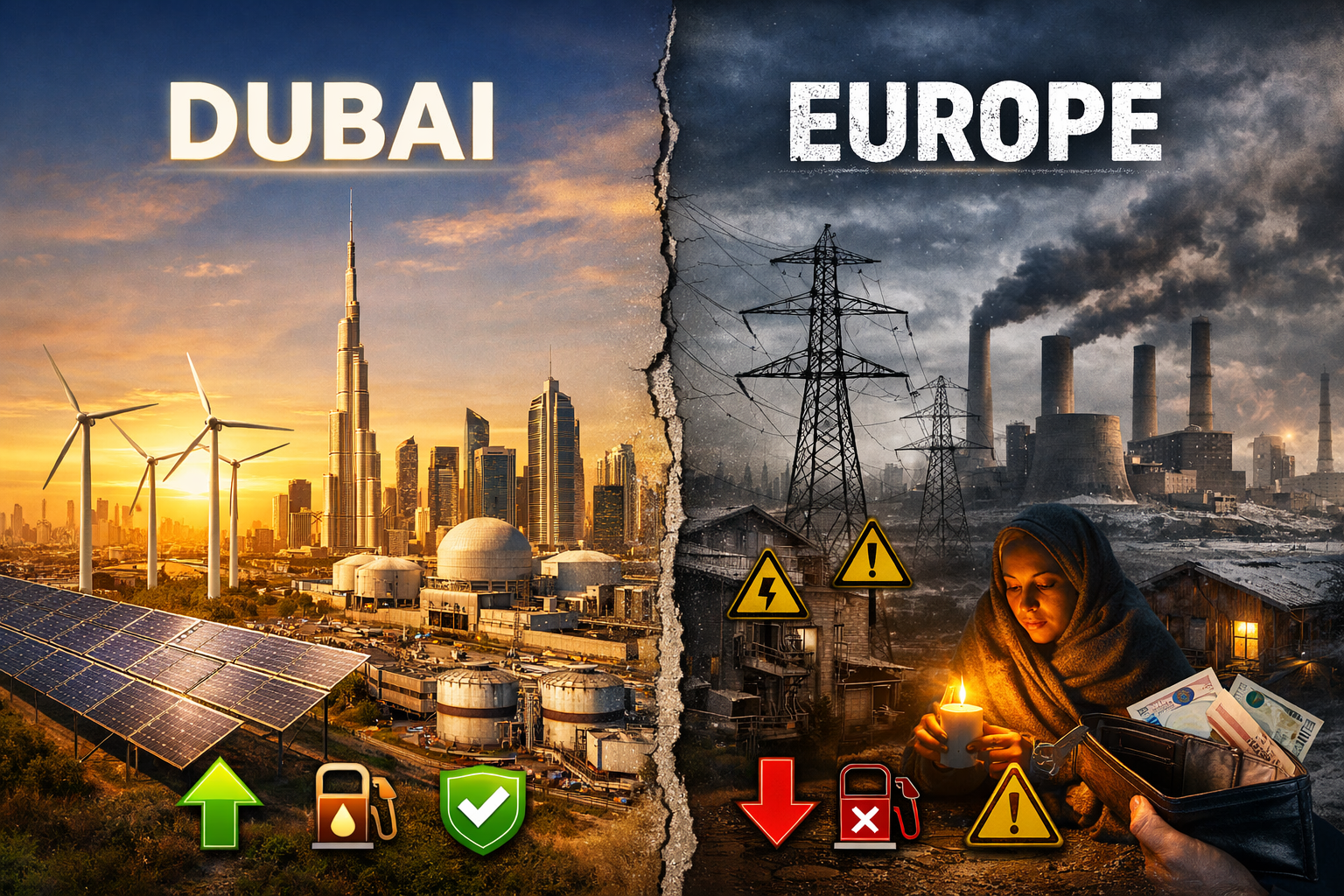
The contrast between Dubai (and the UAE) and Europe reveals two fundamentally different approaches to energy resilience—and two very different outlooks for the future.
The Strait of Hormuz: A Global Bottleneck
The current conflict has significantly reduced energy flows through the Strait, leading to:
- Severe supply disruptions
- Sharp increases in oil and gas prices
- Volatility across global energy markets
In fact, analysts describe the situation as one of the largest energy supply disruptions in modern history, with cascading effects on inflation, logistics, and industrial production. ()
For energy-importing regions, the consequences are immediate and severe.
Europe: Structural Vulnerability Exposed
Europe is once again facing a familiar challenge: dependence.
Despite efforts to diversify after the 2022 energy crisis, the continent remains heavily reliant on imported energy—particularly LNG. The disruption of Qatari supply and reduced flows through Hormuz have led to:
- Gas price increases of over 60–70%
- Tight supply of refined fuels such as diesel and jet fuel
- Increased risk of industrial slowdown and inflation
()
In some cases, governments are already reconsidering energy transition goals in favor of short-term supply security.
The key issue is structural:
Europe consumes energy—it does not control its flow.
Dubai and the UAE: From Exposure to Strategic Positioning
At first glance, the UAE appears equally exposed. A large portion of its exports also passes through the Strait of Hormuz.
However, the strategic reality is very different.
The UAE has spent years investing in energy diversification, infrastructure, and redundancy, including:
- Pipeline routes bypassing the Strait (partial mitigation capacity) ()
- A diversified energy mix including nuclear (Barakah) and renewables
- Strong domestic energy production capacity
- Strategic reserves and integrated energy companies (e.g., ADNOC)
Unlike Europe, the UAE is not just a consumer—it is a producer, exporter, and infrastructure player.
This fundamentally changes its position in times of crisis.
Short-Term Impact on Dubai
Dubai, as a trade and logistics hub, is not immune to disruption. The current situation can lead to:
- Increased shipping and insurance costs
- Temporary volatility in trade flows
- Higher operational costs in logistics and aviation
Additionally, oil price spikes—reaching extreme levels in recent weeks—create broader market uncertainty. ()
However, these effects are largely operational, not structural.
The Strategic Shift: Dubai as a Safe Energy Hub
While Europe is managing scarcity, Dubai is benefiting from repositioning dynamics.
In times of crisis, capital and business activity tend to move toward:
- Stable jurisdictions
- Energy-secure environments
- Logistically connected hubs
Dubai checks all three boxes.
As a result, the crisis is accelerating several trends:
- Relocation of regional headquarters to the UAE
- Increased demand for energy trading and intermediary services
- Growth in infrastructure investment and logistics
- Strengthening of Dubai’s role as a global energy pricing and trading hub
The key insight:
Dubai is not defined by the crisis—it is increasingly defined as the solution to it.
Looking Ahead: Two Different Futures
The divergence between Europe and Dubai is likely to widen.
Europe’s Outlook:
- Continued vulnerability to external supply shocks
- High and volatile energy prices
- Structural pressure on industry and competitiveness
Dubai’s Outlook:
- Strengthened role as an energy and trade hub
- Increased strategic importance in global supply chains
- Long-term attractiveness for capital and business relocation
The Strait of Hormuz crisis is not just a disruption.
It is a catalyst accelerating an already ongoing shift in global energy power.
Strategic Implications for Investors and Businesses
For decision-makers, the implications are clear:
- Energy security is now a core investment criterion
- Geographic positioning matters more than ever
- Stable, diversified hubs will outperform volatile regions
At Golden Falcon Consulting, we support clients in understanding these shifts—not only to manage risk, but to position ahead of structural change.
Because in today’s world, energy is not just a commodity.
It is strategy.
Golden Falcon Consulting advises investors and companies on geopolitical risk, market positioning, and strategic opportunities across the Middle East and global markets.
-

The Start of the WEC Season
Why Endurance Racing Matters More Than Ever for Collectors and Brands Why Endurance Racing Matters…
-

Endurance Racing & Business Leadership
Why Managing a Company Is Like a Long-Distance Race At first glance, motorsport and business…
-
Energy Under Pressure
Dubai’s Strategic Position in the Strait of Hormuz Crisis – and What Europe Can Learn…
