In business, some of the most important decisions are made long before all facts are available.
Markets shift.
Technologies evolve.
Competitors adapt.
Geopolitical realities change.
Waiting for complete certainty often means arriving too late.
This is where intuition comes into play.
But intuition is not magic.
And it is certainly not guesswork.
In reality, intuition is one of the most fascinating intersections between experience, psychology, and human biology.
Intuition Is More Than a Feeling
Many people dismiss intuition as emotion.
Yet neuroscience tells a different story.
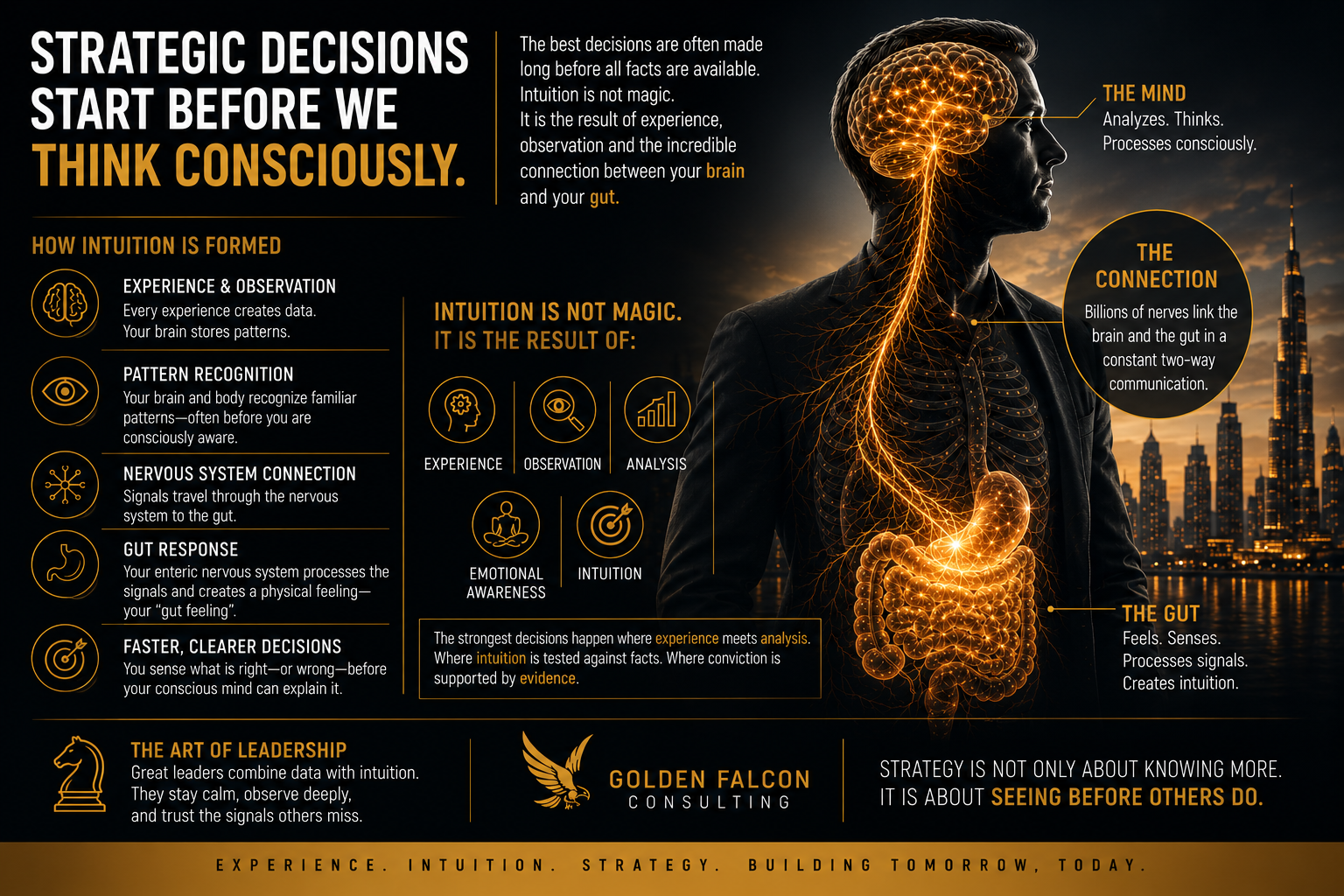
What we commonly call a “gut feeling” is often the result of our brain processing enormous amounts of information below the level of conscious awareness.
Experiences.
Observations.
Conversations.
Failures.
Successes.
All of these create patterns stored within our nervous system.
When a situation resembles a previously experienced pattern, our body often recognizes it before our conscious mind can explain it.
That is why many strategic leaders simply “know” when something feels right—or wrong.
Why We Literally Feel Decisions in Our Gut
Interestingly, the expression “gut feeling” is not just metaphorical.
The human body contains an extensive network of nerves in the abdominal region known as the enteric nervous system, often referred to as the body’s “second brain.”
This network contains hundreds of millions of nerve cells and is directly connected to the brain through complex communication pathways.
When we face uncertainty, risk, or important decisions, information is not processed exclusively in the brain.
Signals travel through the nervous system and are reflected physically in the abdominal region.
This is why people often experience:
- A feeling of tension in the stomach
- A sense of calm when something feels right
- Physical discomfort when something feels wrong
The body is responding to information and patterns that the conscious mind may not yet have fully articulated.
In other words:
The gut feeling is often the nervous system’s early warning—or confirmation—mechanism.
Experience Creates Intuition
A young entrepreneur often relies heavily on analysis.
An experienced entrepreneur combines analysis with intuition.
Why?
Because experience creates a database of patterns.
After years of:
- Leading teams
- Negotiating deals
- Navigating crises
- Building companies
- Making difficult decisions
leaders begin to recognize familiar dynamics.
Different situations.
Similar patterns.
The body and mind work together to identify them.
This is where intuition becomes a genuine strategic asset.
Strategic Thinking Starts with Observation
Every major opportunity begins as a weak signal.
Before markets change, there are indicators.
Before a crisis develops, there are signs.
Before a trend becomes obvious, there are patterns.
Most people miss them because they are focused on daily operations.
Strategic thinkers recognize them because they are constantly observing:
- Markets
- Industries
- People
- Technology
- Global developments
Over time, these observations strengthen both analytical thinking and intuitive judgment.
Pressure Reveals the Quality of Decision-Making
Intuition becomes most valuable when uncertainty increases.
In moments where:
- Data is incomplete
- Time is limited
- Risks are significant
leaders cannot wait for perfect information.
They must decide.
The quality of those decisions depends on the quality of the experience, observation, and judgment accumulated over years.
This is why calm leaders often make better decisions.
When emotions are controlled, intuition can be heard more clearly.
Intuition Without Analysis Is Dangerous
However, intuition alone is not enough.
Successful decision-makers do not choose between intuition and analysis.
They combine them.
The strongest strategic decisions occur when:
Experience meets logic.
Intuition meets data.
Conviction meets evidence.
The best leaders trust their instincts—but they also challenge them.
The Art of Strategic Decision-Making
In today’s complex world, information is available to everyone.
The true competitive advantage is no longer access to information.
It is the ability to interpret it correctly.
And that ability comes from a combination of:
✔ Experience
✔ Observation
✔ Analytical thinking
✔ Emotional control
✔ Intuition
Final Thought
The best strategic decisions are rarely made because someone knew the future.
They are made because someone recognized patterns others overlooked.
Sometimes the mind sees them first.
Sometimes the nervous system does.
And that is why the phrase “trust your gut” has survived for generations.
Because behind every great intuition lies years of experience, countless observations, and a highly sophisticated biological system designed to help us navigate uncertainty.
At Golden Falcon Consulting, we believe that exceptional leadership is built where analytical excellence meets human intuition.
Because strategy is not only about understanding numbers.
It is about understanding signals before they become obvious to everyone else.
This section provides an overview of the blog, showcasing a variety of articles, insights, and resources to inform and inspire readers.
-
Beyond €40 Billion: What the UAE–Germany Partnership Means for Entrepreneurs and Investors The UAE President’s…
-
Monaco Formula 1 2027 – VIP Balcony Experience
Monaco Formula 1 2027 – VIP Balcony Experience The Monaco Grand Prix is more than…
-
Strategic Decisions, Intuition, and Why the Best Leaders Learn to Trust Their Gut
In business, some of the most important decisions are made long before all facts are…
